
The invisible weight: how couples drift into the mental load trap
(And how to reset together)
This topic is one that is a frequent subject with friends as well as clients.
I used to really wonder how on earth families found themselves in this situation where one carries the ‘mental load’ alone. I have three great men in my life who are all perfectly capable (and do) run a home and family life, and I’ve always had partners where we shared not just the tasks, but the thinking too. So a few years ago I tasked myself to understand WHY couples end up in this way, and since I started working with couples, HOW you can change things together.
So in this article I wanted to share with you both how it happens, but more crucially how you can get out of it (and perhaps more importantly – prevent it in the first place). And just as a warning: you’re BOTH responsible for how you got here and how things can change.
THERE’S EVEN A WORKSHEET!!!
What is ‘mental load’
If you have ever found yourself standing in the kitchen, silently seething because you are the only one who knows that the dog is low on food, the school forms are due tomorrow, and the lightbulb in the hallway is flickering, then you are experiencing the mental load.
It is the cognitive labour of managing a household – the anticipating, planning, organising, and tracking. When the mental load falls heavily on one partner (often, though not exclusively, women), it leads to deep resentment. The other partner (often men) ends up feeling constantly criticised, micromanaged, or left out in the cold.
But here is the liberating truth: this dynamic is rarely born out of malice or laziness. Couples almost always drift into this pattern completely unconsciously. By looking through the lens of psychology, we can see exactly how it happens – and how to fix it without falling into the trap of blame or infantilising men.
The perfect storm: attachment and development
To understand how this happens, we have to look at how we are wired.
Under attachment theory, when a relationship feels stressed or disconnected, we tend to fall into automatic survival strategies. One partner often becomes the ‘pursuer’ (anxiously trying to fix things, organise, and regain control), while the other becomes the ‘withdrawer’ (stepping back to avoid conflict or failure). In a household, the pursuer takes over the mental load as a way to manage their anxiety. The withdrawer retreats because doing anything feels like walking into a critique.
This ties perfectly into the Bader – Pearson Developmental Model of couples therapy. Relationships naturally evolve through stages, and the first two are:
1. Symbiosis: The honeymoon phase where you are a perfect, seamless unit.
2. Differentiation: The critical stage where you realize you are two distinct people with different thresholds for cleanliness, punctuality, and urgency.
If a couple struggles to differentiate cleanly, they fall into the Parent – Child Trap.
Instead of two equal adults navigating different styles, one partner steps into the “Parent” role (the organiser, the gatekeeper, the manager) and the other defaults to the “Child” role (the helper who waits for instructions).
Moving beyond the “clueless husband” narrative
Our culture loves the trope of the bumbling, incompetent husband who cannot work the washing machine. But this narrative is toxic. It infantilises men – assuming they lack the capability to manage a home – and it martyrs women.
The reality is systemic, not personal. When one partner assumes the “manager” role, they often unconsciously engage in maternal gatekeeping – redoing tasks, monitoring how things are done, or criticising the other’s methods. When a man tries to step in and is met with, ”No, not that way,” his brain registers that the safest emotional bet is to stop taking initiative.
He isn’t lazy; he is avoiding a landmine. She isn’t a tyrant; she is exhausted from holding the clipboard. It is a loop where neither person is at fault, but both are trapped.
How to reset the system together
If you are already in the thick of this dynamic, you cannot fix it by making a new chore chart. You have to change the underlying relationship contract.
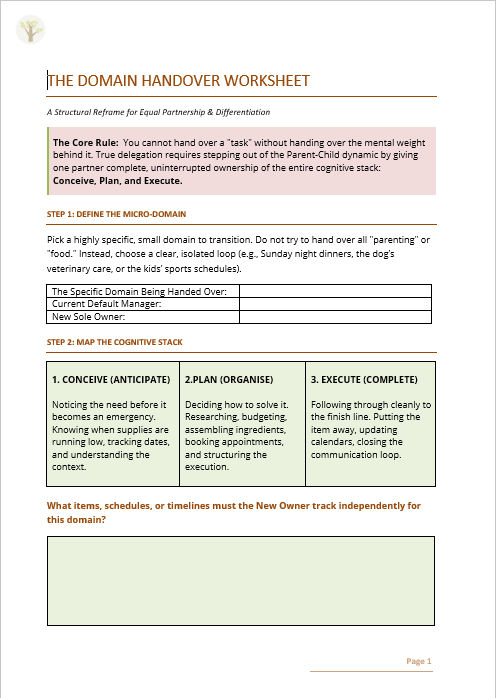
- Shift from “Tasks” to “Ownership”: Instead of asking your partner to “help” with a task (which keeps you in the manager role), hand over entire domains. If your partner takes on dinners, they own the meal planning, the grocery shopping, the cooking, and the cleanup. You have to step back completely and let them execute it their way – even if they buy the wrong brand of pasta.
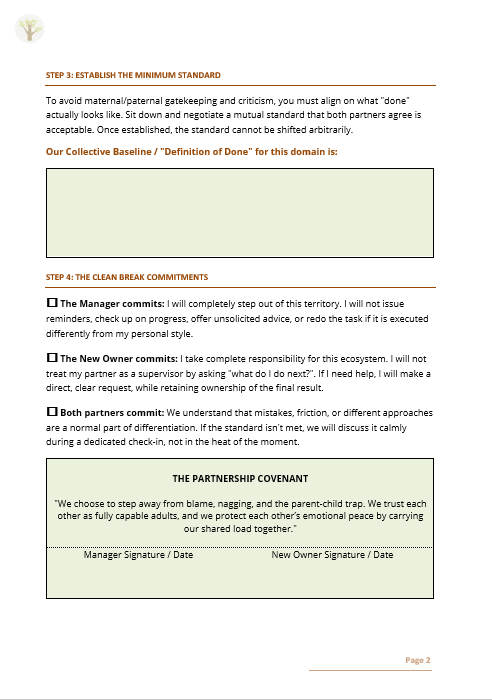
- Establish a Minimum Standard (The Differentiation Work): Sit down during a calm moment – not during an argument – to define what “done” looks like. What is your collective baseline for a clean kitchen or a managed budget? Aligning on the standard prevents the manager from shifting the goalposts.
- Speak to the Vulnerability, Not the Chore: Instead of saying, ”You never think ahead,” try sharing the underlying attachment fear: ”When I have to hold all these details in my head alone, I feel lonely and disconnected from you.”
Today’s action: the “clipboard handover”
If you are stuck in the parent-child loop today, do not try to reallocate the whole household tonight. Instead, pick one tiny micro-domain to hand over completely for the next seven days.
How to do it tonight:
- The ‘Manager’ drops the gatekeeping: Pick a single, low-stakes micro-domain – something like ordering the weekly pet supplies, managing the Friday night dinner plans, or making sure the kids’ school bags are emptied daily
- The Partner takes full ownership: The partner takes over the entire cognitive stack for that one thing: anticipating when it needs to happen, planning it, and executing it. No asking “What should I do?”, and no waiting for a reminder.
- The Agreement: The Manager is legally barred from checking in, reminding, or redoing the task. If the dog food arrives a day late or the wrong takeout restaurant is picked, the world keeps spinning.
The worksheet download below can be a useful tool to help prepare:
Prevention: advice for new couples
If you are early in your relationship or about to move in together, you have a golden opportunity to build immunity against the parent-child trap before it starts.
- Have the “Threshold Conversation”: Talk explicitly about your habits. If one person has a high tolerance for clutter and the other has a low one, acknowledge that gap early. Decide how you will bridge it without one person becoming the default boss.
- Normalise Discomfort: Expect that differentiation will feel bumpy. When you disagree on how to manage the household, see it as a design problem to solve together, not a character flaw in your partner.
- Audit Early and Often: Set a recurring monthly date to check in on the division of mental labour. Treat your household like a startup – experiment with who owns what, iterate on what isn’t working, and keep communication wide open.
By treating the mental load as a shared, systemic puzzle rather than a battle of wills, couples can step out of the parent-child dynamic and back into a true, equitable partnership.