
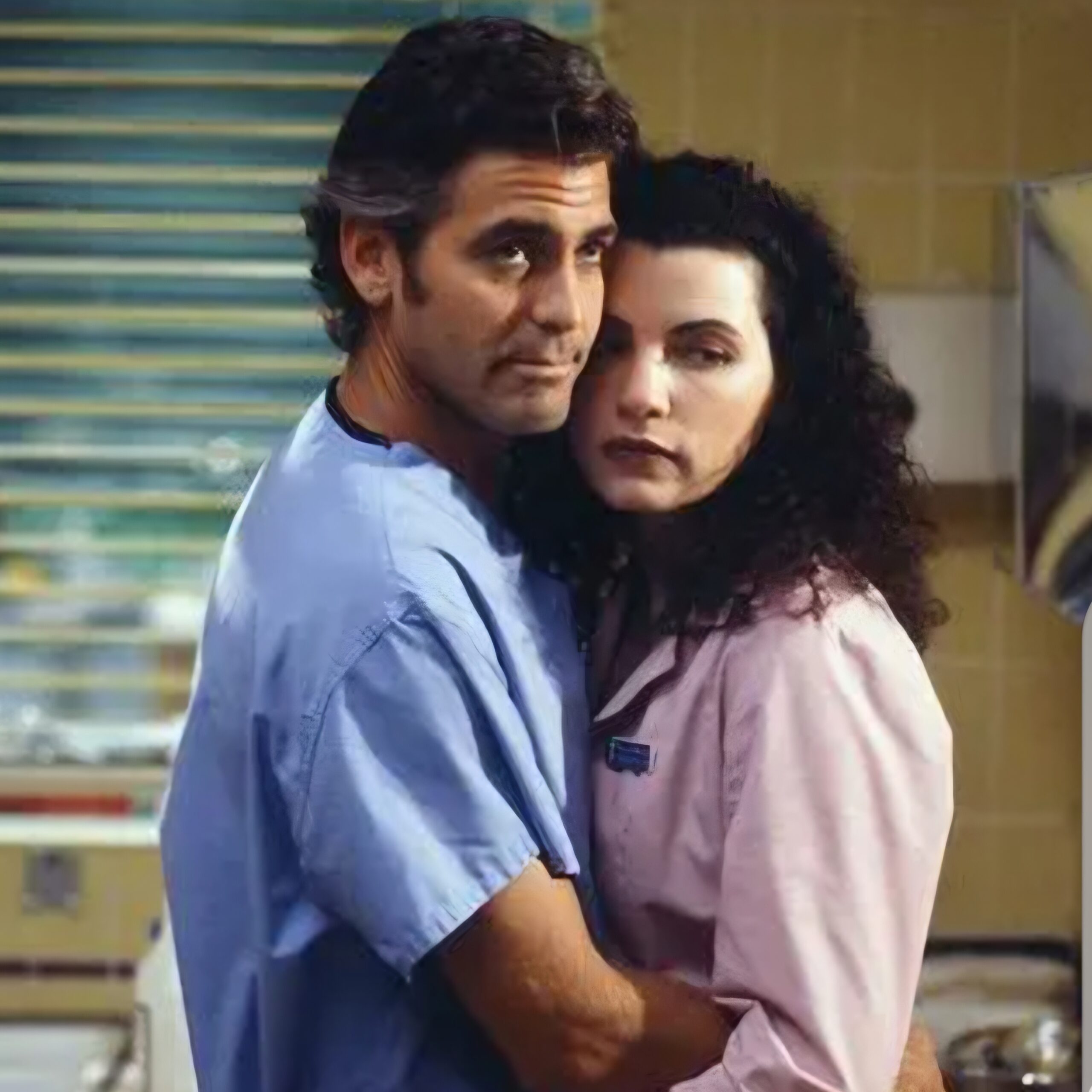
What ER Taught Us About Love (And Why It Was Rubbish)
I’ve recently decided that I’d treat myself to a rewatch of ER (which is going to be a challenge given there are 331 episodes!). I like to rewind after a day of clients so thought that might be a good one for the list. Well. Just a few episodes in, I’m struck by two things: how young they all look, but mainly how incredibly misleading the “Doug and Carol” romance truly was. Frankly, I was annoyed.
Back then, we all sat on our sofas on a Thursday night – 9:00pm on Channel 4 – gripped by the palpable chemistry between George Clooney and Julianna Margulies. We cheered when they finally got back together, viewing their intensity as the ultimate “meant to be.” But watching it now with a therapist’s eye, the nostalgia is tempered by a massive sense of irritation. I see two people who, in the real world, would (at best!) have likely ended up in a very messy, very exhausting stalemate.
The 90s Trap: High Drama as “Soulmate” Proof
In the 90s, television and film drama was built on the “Will-They-Won’t-They” trope. The more obstacles, the more tears, and the more shouting matches in the rain, the more “true” the love was supposed to be. ER perfected this with Doug and Carol. From Carol’s heartbreaking pilot episode to Doug’s constant self-destruction, we were sold a version of love that required constant crisis to feel valid.
As a therapist, I see the “Doug and Carol” legacy in my office all the time. Clients often come in feeling that their stable, kind relationship is “boring”, or have a history of ending relationships after a couple of years, all because it doesn’t have the adrenaline spikes.
We’ve been conditioned to mistake anxiety for butterflies and instability for passion. If there isn’t a “threat” of losing the person, we wonder if the spark has gone out. In reality, that “spark” is often just our nervous system stuck in a fight-or-flight response.
The Myth of Symbiosis
The 90s was the decade of Symbiosis. You know the trope: that “two halves of a whole” idea where you’re supposed to lose yourself in another person to prove your love. On screen, it looks like Doug Ross walking away from his career because he can’t breathe without Carol.
In my work, I see the reality behind that “push and pull.” It’s often just a painful dance between Anxious and Avoidant attachment.
Doug Ross was the “Poster Boy” for Dismissive-Avoidant Attachment. He was charming, heroic in a crisis, and incredibly talented, yet he carried an emotional “No Trespassing” sign. Whenever Carol got too close, or whenever life required real vulnerability, Doug would bolt – either into the arms of another woman or into a self-sabotaging career move.
Carol, on the other hand, often operated from Anxious Attachment. After her initial heartbreak, much of her arc involved trying to predict Doug’s moods, waiting for him to change, and sacrificing her own emotional stability to be his “anchor.”
When one person is constantly retreating and the other is constantly chasing, nobody is actually connecting; they are just reacting to their own deep-seated fears of abandonment or engulfment.
Being a ‘Me’ While Being a ‘We’: The Developmental Model
To understand why Doug and Carol were fundamentally stuck, we can look at the Bader-Pearson Developmental Model of relationships. This model suggests that relationships move through stages, much like children do as they grow up. The first two stages (of five in total) are relevant here:
1. Bonding: The “Honeymoon” phase. You merge. You love the same music; you finish each other’s sentences. It’s lovely, but it’s meant to be temporary. Attempts to stay in this phase are described as symbiosis
2. Differentiation: This is where the real work begins. This is the “Wait, you like that? I hate that” phase. It’s about becoming two distinct individuals again while staying connected.
Doug and Carol never quite made it to Differentiation. They were “enmeshed” or “symbiotic” – a state where one person’s bad mood or erratic behaviour completely hijacks the other’s life.
In a symbiotic relationship, is where you’re trying desperately to stay in the first, bonding stage, but the consequence of that is your partner’s distress becomes your distress. You want things to feel like they did at the beginning – when you didn’t seem to be such different people. The result is that you find yourself feeling responsible for their happiness and terrified of their disapproval. It can show up as anger, anxiety, or avoidance.
True relationship goals aren’t about finding someone who “completes” you; it’s about being two whole, independent people choosing to walk side-by-side.
Why We Still Long for the Drama
If this “symbiotic” love is so damaging, why did we spend fifteen seasons rooting for it? And why do we still look for it in our own lives?
It isn’t because it’s comforting – it’s because it’s addictive. The “Will-They-Won’t-They” cycle creates a powerful dopamine loop in our brains. When things are bad, we are in a state of high stress; when the grand gesture finally happens or the apology comes, our brain is flooded with feel-good chemicals. We become hooked on the “high” of the reconciliation, which makes the “low” of the conflict feel worth it.
But in reality, love doesn’t conquer a lack of boundaries. It doesn’t conquer a refusal to communicate or a habit of running away when things get difficult. Real love is what happens after the airport reunion, when you have to decide who is doing the washing up and how to handle a disagreement about the mortgage.
Real Life Isn’t a Romantic Medical Drama
If you’re rewatching these old boxsets and feeling like your own marriage or partnership lacks that “TV spark,” honestly? Be glad. Real, healthy love is usually much quieter than a frantic hallway in County General.
It’s built on stability, clear boundaries, and the freedom to be yourself without walking on eggshells. It’s about being able to say “I’m upset” without the other person running for the hills, and being able to spend time apart without feeling panicked. It’s the difference between a rollercoaster and a walk in the Peak District. One is a thrill ride that leaves you feeling sick; the other is a bit of effort but leaves you feeling grounded and refreshed.
The “Differentiation Audit”
If you recognise a bit of Doug or Carol in your own life, you don’t necessarily need to jump straight into the therapist’s chair to start making changes. A great way to begin breaking the “symbiosis trap” is to perform a Differentiation Audit.
Take a quiet moment this week to look at your “Me” time versus your “We” time.
Ask yourself: “When was the last time I did something purely because I enjoyed it, regardless of whether my partner liked it or approved of it?”
Start small. It might be going for a walk along the Trent on your own, choosing a book your partner would never read, or simply saying “actually, I’d prefer Italian tonight” when they suggest a takeaway.
By practicing these tiny moments of “individualness,” you’re training your relationship to handle the fact that you are two separate people. It builds the “differentiation muscle” so that when bigger disagreements happen, they don’t feel like a threat to your entire existence.
Taking the Next Step
We can unlearn the 90s drama. We can move past the misleading images of symbiosis and build something much more sustainable. Whether you’re navigating a relationship or working on yourself, there is a path toward feeling more secure.
As you continue your rewatch, do you find yourself spotting these patterns in other TV couples too? It’s amazing how once you see the “symbiosis trap,” you see it everywhere!